Partner Ogden Codman, Jr.
Queer Places:
6 Beacon St, Boston, MA 02108, USA
Old Episcopal Churchyard, 62 Church Ln, North Kingstown, RI 02852, United States
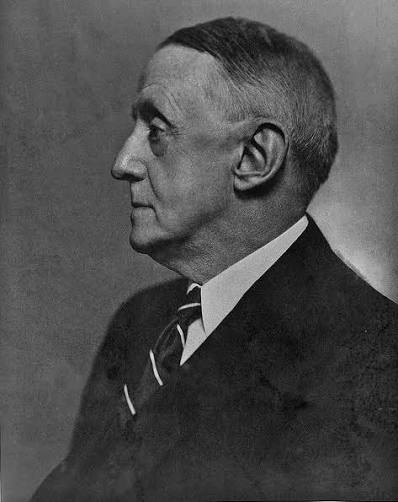 Daniel Berkeley Updike (February 24, 1860 - December 28, 1941) was born in Providence, Rhode Island, on February 24, 1860, and emerged as one of the most prominent American
printers, typographers, and book designers of the late nineteenth and early twentieth centuries. Descended from an old and established Rhode Island family, Updike began his
professional career working for the Riverside Press of Houghton Mifflin in Boston, where he developed a deep appreciation for the history and craftsmanship of bookmaking.
Inspired by the Aesthetic Movement and the broader Arts and Crafts ideals of the era, he left Houghton Mifflin to found his own printing enterprise in Boston in 1893. He
named it the Merrymount Press, an overt historical allusion to Thomas Morton's seventeenth-century colonial settlement known for its defiance of Puritan austerity. Under
Updike's meticulous direction, the Merrymount Press achieved international renown for its scholarly precision, elegance, and commitment to traditional typography, producing
distinguished work for elite clients, institutions, and prominent authors, including Edith Wharton, who specifically requested his
services for several of her books, and Ned Warren.
Daniel Berkeley Updike (February 24, 1860 - December 28, 1941) was born in Providence, Rhode Island, on February 24, 1860, and emerged as one of the most prominent American
printers, typographers, and book designers of the late nineteenth and early twentieth centuries. Descended from an old and established Rhode Island family, Updike began his
professional career working for the Riverside Press of Houghton Mifflin in Boston, where he developed a deep appreciation for the history and craftsmanship of bookmaking.
Inspired by the Aesthetic Movement and the broader Arts and Crafts ideals of the era, he left Houghton Mifflin to found his own printing enterprise in Boston in 1893. He
named it the Merrymount Press, an overt historical allusion to Thomas Morton's seventeenth-century colonial settlement known for its defiance of Puritan austerity. Under
Updike's meticulous direction, the Merrymount Press achieved international renown for its scholarly precision, elegance, and commitment to traditional typography, producing
distinguished work for elite clients, institutions, and prominent authors, including Edith Wharton, who specifically requested his
services for several of her books, and Ned Warren.
Updike's life and career were deeply intertwined with Boston's artistic, intellectual, and bohemian circles, which included various figures who defied Victorian social
conventions. As documented in queer histories such as Improper Bostonians, Updike moved within a network of gay and unconventional men and women who shaped New England
cultural life at the turn of the century. Alongside Russell Sullivan, Updike notably encouraged and supported figures
like Amy Lowell when she hosted a daring production of Oscar Wilde's play An Ideal Husband in
1907-1908, during a period when Wilde's name was heavily ostracized in polite society. Updike was also close friends with the pioneering interior designer
Ogden Codman, with whom he may have had a romantic relationship; Updike notably assisted Codman's career by designing The
Decoration of Houses, the influential book Codman co-authored with Edith Wharton. Other members of Updike's broader social and artistic orbit included the architect
Ralph Adams Cram, the poet Louise Guiney, and the artist
Thomas Meteyard, cementing Updike's status as a central figure among Boston's turn-of-the-century aesthetes.
Beyond his direct commercial printing output, Updike made a monumental and enduring contribution to typographic history through his scholarly writing. His masterwork,
Printing Types: Their History, Forms, and Use, originally published in two volumes in 1922 based on his lectures at Harvard University, remains a foundational text in the
field and is still in print today. Updike's philosophy emphasized that the primary purpose of printing is to communicate information clearly and gracefully rather than to
serve as a vehicle for mere artistic display. He continued to manage the Merrymount Press with unwavering dedication until his death on December 28, 1941, in Boston, leaving
behind a legacy that permanently elevated the standards of American book design and typography.
References:
Other references:
- Winship, George Parker. Daniel Berkeley Updike and the Merrymount Press of Boston, Massachusetts, 1860-1941. Rochester, NY: The Printing House of Leo Hart, 1947.
- Updike, Daniel Berkeley. Printing Types: Their History, Forms, and Use: A Study in Survivals. 2 vols. Cambridge: Harvard University Press, 1922 (reprinted by Oak Knoll Press, 2001).
- Updike, Daniel Berkeley. In the Day's Work. Cambridge: Harvard University Press, 1924.
- Hunter, Martin. The Merrymount Press: An Exhibition on the Occasion of the 100th Anniversary of the Founding of the Press. Cambridge: Harvard University Press, 2005.
Support this project
This website is a passion project researched, developed, and funded entirely by me. If you find the content valuable and would like to help support the ongoing research and hosting costs, any contribution is deeply appreciated.
Thank you for keeping this independent resource alive!
My books on Amazon: Elisa Rolle's books
BACK TO HOME PAGE